

|
||
|
|
||
|
||
|
A message from the Durham Police and Crime Commissioner... We must be braver to save more lives. |
||
|
We must be braver to save more lives LAST week, the Government published the first national Road Safety Strategy in more than a decade. This really matters because for too long, deaths and serious injuries on our roads have been treated as inevitable accidents. They are not accidents, they are often preventable collisions caused by the fatal four factors – speeding, drink/drug driving, not wearing seat belts or using mobile phone.
Road safety is not a minor issue. It is central to my plans, underpinned by a clear ambition of achieving Vision Zero – every day without a road death. That is why I welcome the publication of this strategy. The strategy gets several things right. It sets clear national targets: a 65% reduction in people killed or seriously injured by 2035, and a 70% reduction for children.
It places the Safe System at its heart – recognising that while people make mistakes, our roads, vehicles, and laws must be designed to prevent those mistakes being fatal. I strongly welcome the government’s proposals to consult on a lower drink-drive limit, an even lower limit for novice drivers, mandatory eyesight testing for older drivers, and tougher action against dangerous behaviours such as seatbelt non-use, mobile phone distraction and illegal number plates.
These measures reflect what residents consistently raise with me and align closely with work already underway through Durham Constabulary and partners. Where this strategy does not yet go far enough is in protecting young and inexperienced drivers. While a minimum learning period is proposed, it stops short of fully embracing Graduated Driver Licensing – a proven, evidence-based approach that saves lives. The evidence is overwhelming, and the cost of delay is measured not in reports, but in funerals and hospital wards.
There is also a hard truth we must confront: targets without funding will not deliver change.
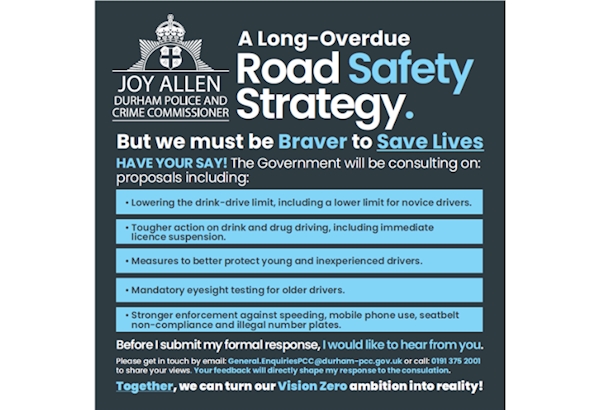
Stronger enforcement of drink and drug driving, tackling uninsured vehicles, ghost plates and persistent speeding all require sustained investment in roads policing, forensic testing and technology. The Government will be consulting on proposals including: Lowering the drink-drive limit, including a lower limit for novice drivers; Tougher action on drink and drug driving, including immediate licence suspension; Measures to better protect young and inexperienced drivers; Mandatory eyesight testing for older drivers; Stronger enforcement against speeding, mobile phone use, seatbelt non-compliance and illegal number plates.
Before I submit my formal response, I would like to hear from you. Email general.enquiriesPCC@durham-pcc.gov.uk or call 0191 375 2001.
| ||
Reply to this message | ||
|


|